Static, Residual and Dynamic Water Pressure Explained
A strong static reading does not prove the remote fixture will have enough pressure when the building is flowing at design demand.
Pstatic → Presidual
Static, Residual and Dynamic Water Pressure Explained
Original MEPFlow engineering guide
Prepared to help mechanical designers understand the calculation, assumptions and review checks. Examples are original and educational; verify the governing code, project criteria and equipment data before using a result for construction or permit documents.
Static pressure is measured when there is no relevant flow. Residual pressure is the pressure remaining at a point while a stated flow is occurring. Dynamic or flowing pressure is often used more generally for pressure under operating conditions. The flow rate and measurement locations must accompany any residual-pressure value.
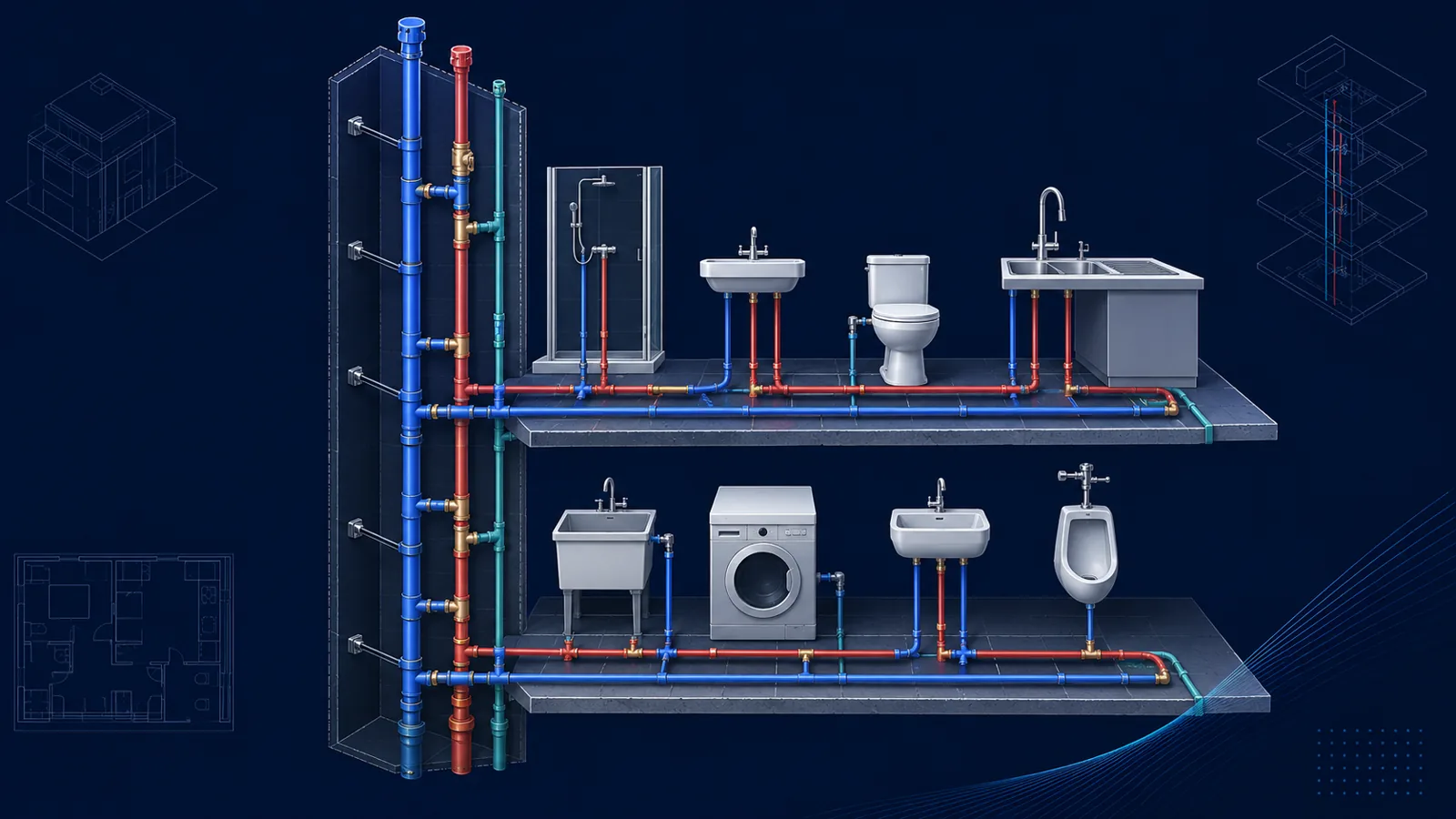
Plumbing design begins with available pressure and subtracts elevation, pipe friction, fittings, devices and equipment. What remains at the controlling fixture is compared with its required pressure.
The pressure budget
Incoming pressure is not all available to overcome pipe friction. Raising water consumes pressure through elevation. Backflow preventers, meters, treatment equipment and control valves can take large portions of the budget.
The design path typically runs from the service connection to the hydraulically most demanding fixture, not simply the most distant fixture.
Engineering visual
Follow the pressure from source to fixture
Source
Static / residual
Use pressure at a stated test flow
System losses
Elevation + friction + devices
Subtract each loss on the controlling path
Fixture
Required residual
Verify pressure at design demand
Premaining = Psource − Pelevation − Ppipe − Pdevices
The remaining pressure must meet or exceed the required operating pressure at the controlling outlet or equipment connection.
Why static pressure can mislead
A gauge may show excellent pressure overnight when demand is low. During a high-demand period, utility pressure can fall and service friction increases. Designing from the static reading alone can overstate available pressure.
Where reliable utility data is unavailable, a flow test records static pressure, residual pressure and flow together. The design basis should reflect expected minimum conditions, subject to local utility and code requirements.
Elevation and friction
In water systems, every foot of elevation requires about 0.433 psi, or approximately 2.31 feet of water per psi. A fixture 60 feet above the service therefore consumes about 26 psi before pipe and device losses are considered.
Pipe friction rises rapidly with flow and falls as internal diameter increases. Diversified demand, actual internal diameter and the selected friction method all affect the result.
| Item | Pressure |
|---|---|
| Available residual pressure | 60 psi |
| Elevation to upper floor | −26 psi |
| Meter/backflow/devices | −8 psi |
| Pipe and fittings | −10 psi |
| Remaining at fixture | 16 psi |
When a booster or pressure-reducing valve is needed
If the minimum source pressure cannot satisfy the controlling fixture after losses, a booster system or a different zoning arrangement may be required. If source pressure is excessive, pressure-reducing valves and pressure zones protect fixtures and maintain manageable operating pressure.
Tall buildings often require both boosting and pressure reduction at different levels. Static pressure at the bottom of a zone can be high even when the top fixture is marginal.
Worked domestic-water pressure budget
Assume 70 psi is available at the building service under the utility's stated flow condition. The highest fixture is 55 ft above the service entry, which consumes about 23.8 psi using 0.433 psi per foot of water elevation. A backflow preventer is selected at 9 psi loss, the meter and service piping use 5 psi, and the interior critical path uses another 8 psi. If the controlling fixture requires 15 psi residual pressure, the budget is 70 - 23.8 - 9 - 5 - 8 - 15 = 9.2 psi remaining.
That 9.2 psi is not automatically excess available for a pressure-reducing valve. The source pressure may vary by time, season or future development; the backflow loss changes with flow; and pipe roughness or fixture demand may differ from preliminary assumptions. The engineer should identify the minimum reliable source pressure at design flow and decide how much explicit contingency is justified.
A static gauge reading of 90 psi at night would not invalidate the budget. Static pressure can be higher when the distribution system has little demand. Design is controlled by residual pressure while the required flow is occurring. Conversely, a low static reading can indicate a source problem before building friction is even considered.
| Item | Pressure effect |
|---|---|
| Source pressure at design flow | +70.0 psi |
| 55 ft elevation | -23.8 psi |
| Backflow preventer | -9.0 psi |
| Meter and service piping | -5.0 psi |
| Interior pipe and fittings | -8.0 psi |
| Required fixture residual | -15.0 psi |
| Remaining design margin | 9.2 psi |
Measure pressure in a way that supports design
A useful field test records gauge location and elevation, static pressure, flowing pressure, simultaneous flow and time of day. A residual pressure with no measured flow is incomplete. For existing buildings, log pressure during representative peak periods if possible. Coordinate with the water authority for available-flow or hydrant-test data and understand how the test location relates hydraulically to the service connection.
Dynamic pressure describes the velocity component of the fluid's energy and is not the same as the residual gauge pressure commonly discussed in plumbing design. In a practical building pressure budget, the measured flowing gauge pressure is the starting boundary condition, while calculated elevation, friction and device losses are subtracted along the critical path.
If the budget is deficient, increasing pipe size only reduces the friction portion. It cannot recover elevation loss or a device's required pressure drop. A booster system may be needed when minimum source pressure cannot satisfy the critical fixture. Where pressure is excessive at lower floors, zoning or pressure-reducing valves may be required even if the top floor is adequate.
- Request minimum and maximum utility pressure, not only a single average value.
- Record flow whenever a residual pressure is measured.
- Correct measurements to a common elevation before comparison.
- Use manufacturer pressure-drop data for meters, backflow devices, valves and equipment.
- Review both the highest critical fixture and lower-floor overpressure conditions.
Frequently asked questions
What is the difference between static and residual pressure?
Static pressure is measured without relevant flow. Residual pressure is measured while a stated flow is occurring.
How much pressure is lost per foot of elevation?
For water, approximately 0.433 psi per vertical foot, or about 9.81 kPa per metre.
Which fixture controls the pressure calculation?
The controlling fixture is the path with the greatest combined requirement from elevation, friction, devices and minimum operating pressure.
Primary references
Use the edition and method accepted for your project. These authoritative resources provide further context; this article is educational and is not a code-compliance determination.